Yes, AI-generated content often makes brands sound remarkably similar. These tools draw from the same training data and default to safe, middle-ground language that could belong to almost anyone. But here's the thing: the real problem isn't AI itself. It's businesses using AI without a clearly defined brand voice to guide it.
For Irish SMEs competing against larger players with bigger budgets, sounding like everyone else is a fast track to invisibility. The solution isn't abandoning AI altogether. It's developing a distinctive brand voice that acts as your filter for all content, whether human-written or AI-assisted. That's where professional copywriting services and solid brand strategy make all the difference.
Why Does AI Content Often Sound the Same?
AI writing tools are trained on massive datasets of existing content from across the internet. They learn patterns, predict what words typically follow other words, and optimise for outputs that are generally acceptable rather than distinctively yours.
The result? Content that reads as competent but generic. Professional but forgettable. It hits all the expected notes without ever surprising anyone.
Give the same prompt to 10 different businesses, and you'll get 10 variations of essentially the same copy. These tools are designed to be helpful to everyone, which means they're distinctive to no one.
That's not a flaw in the technology. It's simply what happens when you ask a tool trained on average content to produce something above average.
What's the Real Risk for Irish Businesses?
The Irish market is competitive. Whether you're in food and beverage, professional services, tech, or healthcare, you're fighting for attention against established brands and well-funded newcomers alike.
Marketing leaders are under genuine pressure to produce more content, faster, across more channels. The temptation to lean heavily on AI is completely understandable. It solves a real resource problem.
But if your LinkedIn posts, website copy, and email campaigns sound like your competitors', you're essentially spending money to blend in. You're creating content that fills space but doesn't build recognition or preference.
Brand consistency suffers, too. Without a voice framework guiding content creation, different team members (and different AI sessions) produce copy that feels disjointed. Your audience can't build a relationship with a brand that sounds different every time they encounter it.
How Do Distinctive Brands Sound Different?
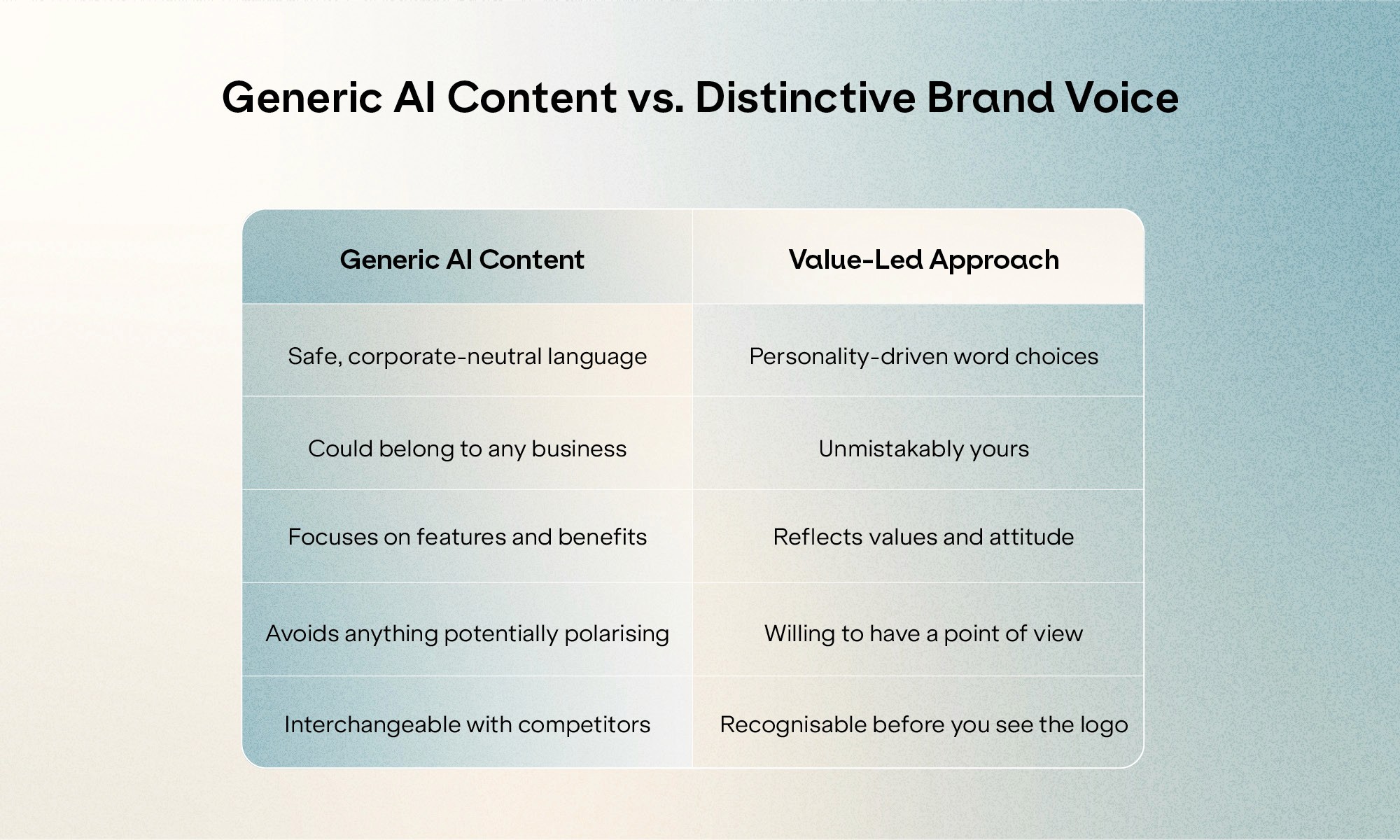
Think about brands you'd recognise without seeing a logo. Ryanair's social media is unapologetically direct, leaning into self-aware humour about being a budget airline rather than pretending otherwise. Innocent Drinks built an empire on packaging copy that sounds like a witty friend rather than a corporation. Oatly is deliberately provocative, willing to be polarising because they know bland doesn't build loyalty.

What do these brands have in common? A defined personality that guides every piece of content they create. They've made deliberate choices about how they sound, what they'd say, and crucially, what they'd never say.
You recognise them before you read the company name. That distinctiveness can't be replicated by AI working from a generic prompt like "write engaging social media copy for a drinks brand."
How Can You Protect Your Brand Voice from AI Homogenisation?
Start with strategy, not tools. Before you worry about how to use AI effectively, get clear on what your brand actually sounds like.
Document your voice. Write down your tone, your typical vocabulary, phrases you love, and phrases you'd never use. Create guidelines specific enough that someone unfamiliar with your brand could write in your voice after reading them.
Then use those guidelines to brief both humans and AI. The clearer your inputs, the more distinctive your outputs.
Treat AI as a starting point, not the final word. Every piece of content should pass a simple test: could this have come from anyone, or is it unmistakably ours? If it's the former, it needs work.
Brand Voice Protection Checklist
• Documented brand voice guidelines exist and are current
• Content is reviewed against voice standards before publishing
• AI outputs are edited through your brand filter
• Team members can articulate what your brand would and wouldn't say
• Regular audits check for voice drift across channels
When Should You Bring in Professional Help?
Some businesses can develop their voice internally. But if you're struggling to articulate what makes you different, an external perspective often helps. Fresh eyes catch things you've become blind to.
If your content already sounds generic and you can't pinpoint why, or if you need to scale production without losing distinctiveness, professional support pays for itself. Strategic copywriting services bring both the thinking and the execution. Brand messaging lays the foundation for everything else.
Ready to Sound Like Yourself?
AI isn't going away, and it shouldn't. The businesses that thrive will use it as a tool, not a replacement for a distinctive voice.
Your brand voice is a competitive advantage worth protecting. If you're unsure whether your content sounds like you or like everyone else, we'd be happy to chat about where you are and where you want to be. Get in touch with us.