Irish businesses need separate brands when a single brand identity can no longer credibly serve different audiences, products, or market positions. The decision comes down to whether your existing brand naturally extends into new territory, or whether trying to stretch it would confuse customers and dilute what made the original brand strong. Getting this right is a core part of brand architecture and one of the most consequential strategic decisions a growing business will make.
What Is Brand Architecture and Why Does It Matter?
Brand architecture is simply the way a business organises its brands, products, and services into a structure that makes sense to customers. Think of it as a family tree for your business. Some families keep everything under one surname. Others give each branch its own identity.
The reason it matters is practical. When your business grows beyond a single product or service, customers need to understand what you offer and who each offering is for. If that structure is unclear, people get confused. Confused people do not buy.
For Irish SMEs and family businesses, brand architecture decisions tend to arise at specific moments: launching a new product line, expanding into export markets, acquiring another business, or passing the business to the next generation who wants to take it in new directions.
What Are the Main Brand Architecture Models?
There are three broad approaches, and most Irish businesses will find their answer somewhere among them.
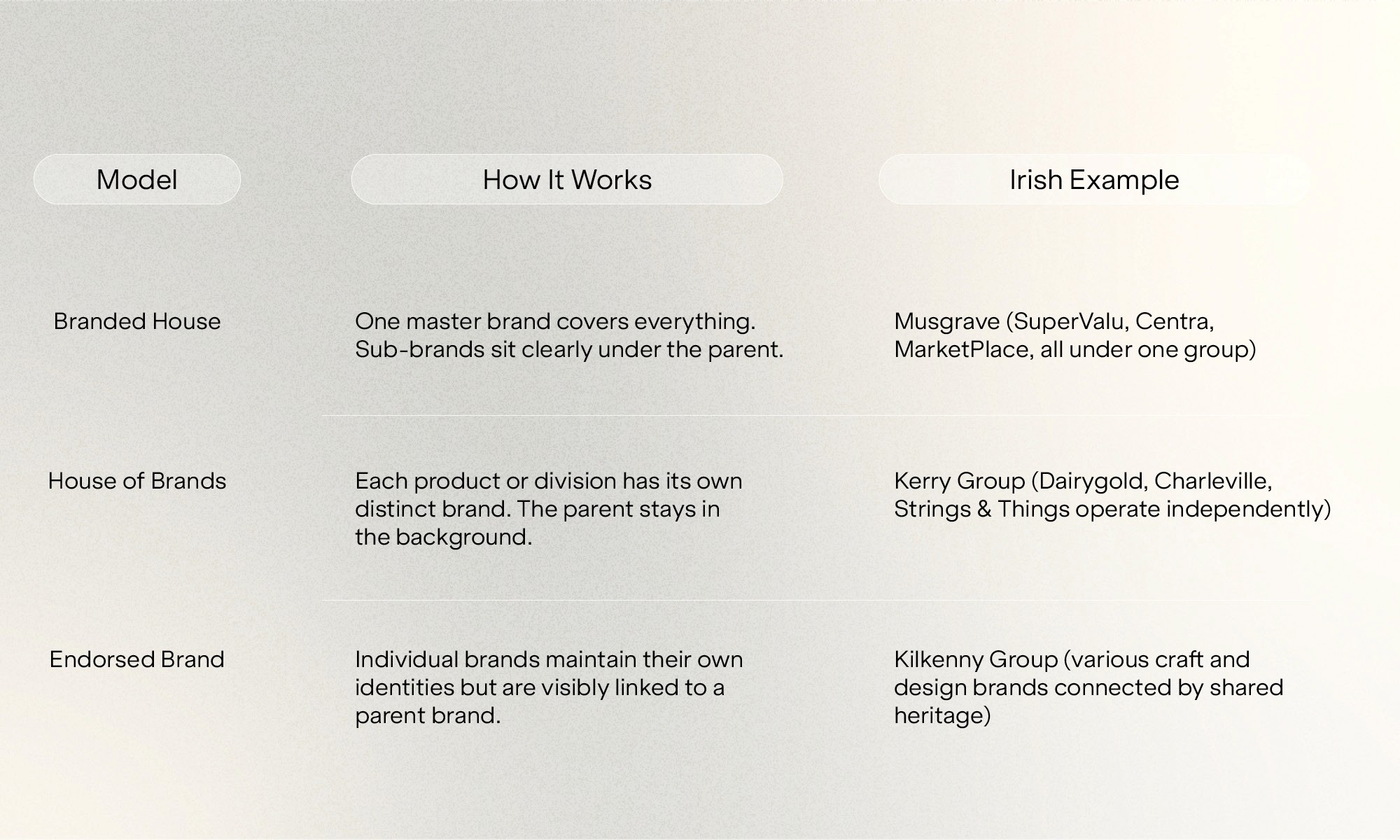
None of these models is inherently better than the others. The right choice depends on your business, your customers, and where you are heading.
When Does a Single Brand Stop Working?
A single brand works well when everything you offer shares a common audience, a common quality standard, and a common set of values. Gym+Coffee, for example, stretches across activewear, accessories, and coffee because its lifestyle positioning connects them all.
It stops working when the stretch becomes a strain. Here are the signals:
• Your new product targets a fundamentally different customer than your existing one
• The price positioning of the new line conflicts with expectations set by the original brand
• You are entering a market where your existing brand carries no recognition or credibility
• Customers are confused about what your business actually does
• A family business is diversifying into sectors unrelated to the founder's original trade
For family businesses in particular, this question often surfaces during generational transitions. The founder built the brand around one thing. The next generation wants to expand into adjacent areas. The question is whether the original brand name can carry that weight on its own or needs support.
How Do Irish Businesses Get This Decision Right?
Start with your customer, not your org chart. The question is not what makes sense internally. It is what makes sense to the person buying from you.
Ask three questions. First, would your existing customers be surprised or confused to see this new product under your current brand? Second, does the new product share the same values, quality level, and audience as your existing range? Third, would a separate brand give the new product a better chance of success in its target market?
If the answers point toward separation, that does not automatically mean building an entirely new brand from scratch. An endorsed model, where the new brand benefits from the parent's credibility while establishing its own identity, often gives Irish SMEs the best of both worlds.
In our experience working with Irish businesses over the past decade, the most common mistake is not launching too many brands. It is launching too few and stretching a single brand until it means nothing specific to anyone. A focused brand with a clear audience will always outperform a vague one trying to be everything to everyone.
Ready to Organise Your Brand for Growth?
Brand architecture decisions shape how customers understand your business for years to come. Whether you are launching a new product, expanding into export markets, or preparing your family business for its next chapter, getting the structure right now saves significant time and money later. If you are facing this kind of decision, we would be happy to talk it through. Get in touch with us.