A good brand brief gives your agency everything they need to do its best work. It should communicate your business goals, your audience, your competitive landscape, and the problem you are trying to solve. It does not need to be long or polished. It needs to be honest. The brief is the foundation of brand strategy development, and getting it right saves time, money, and frustration on both sides.

Why Does the Brief Matter So Much?
The brief is where the relationship between a business and its agency begins in practice. A vague brief produces vague work. A brief that focuses entirely on what the brand should look like, without explaining who it is for or what problem it solves, results in creative that looks attractive but underperforms.
We see two common patterns. First-time founders often struggle to put their vision into words because they have never had to articulate it before. Everything exists in their heads as feelings rather than as strategies. Second-generation business owners face a different challenge: they need to honour the brand's heritage while steering it in a new direction, and balancing that tension requires real clarity.
In both cases, the brief is not a test. It is a conversation starter. A good agency will use it to ask the right follow-up questions and fill in the gaps together.
What Should a Brand Brief Include?
You do not need a 20-page document. You need clear answers to the questions that matter most.
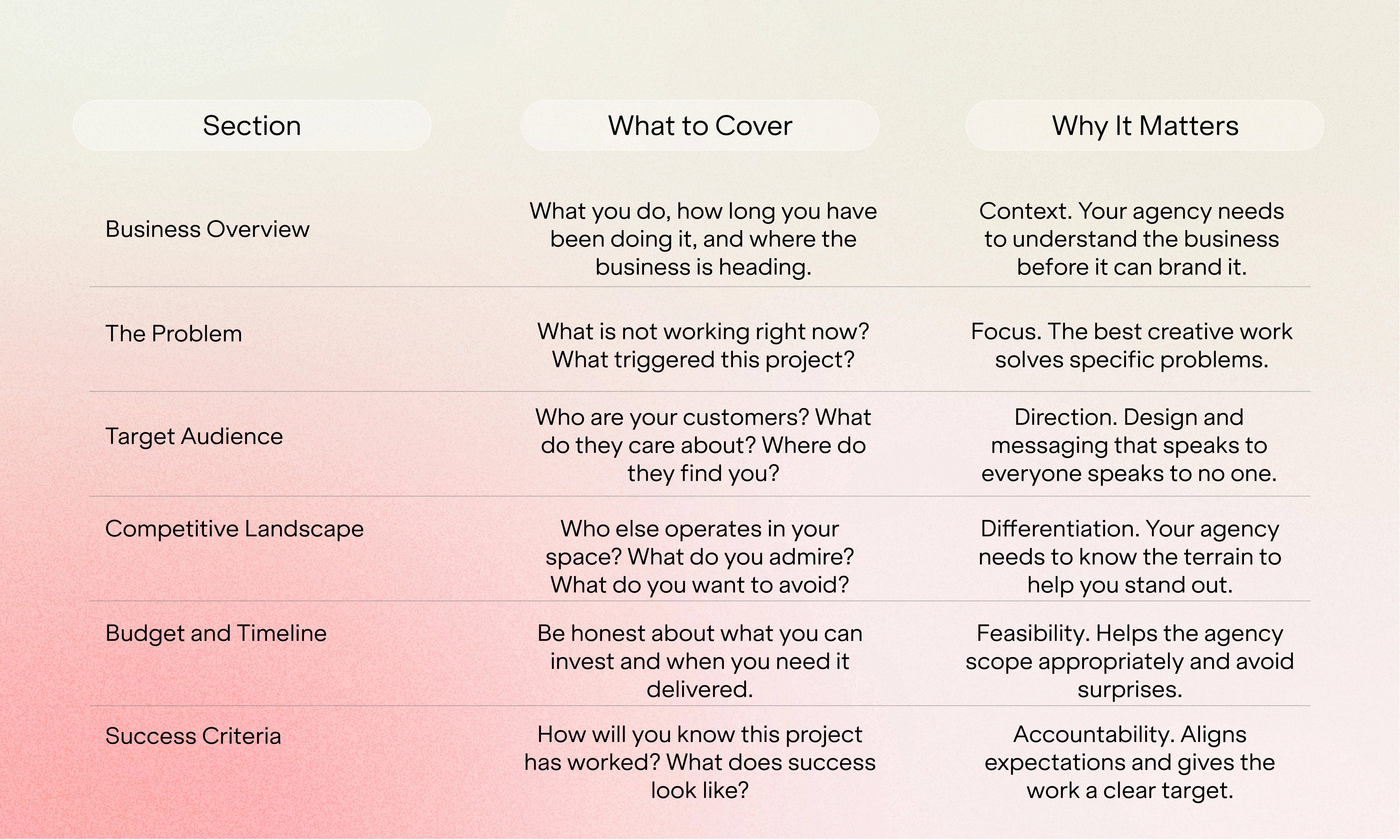
That is it. Six sections. If you can answer those questions honestly, even briefly, you have a strong brief.
What Are the Most Common Briefing Mistakes?
The mistakes we see most often are well-intentioned but counterproductive.
• Prescribing the solution instead of describing the problem ("We need a green logo" rather than "We need to stand out in a crowded market")
• Leaving out the audience because it feels obvious (it is never as obvious as you think)
• Being vague about the budget makes it impossible for the agency to scope properly
• Trying to impress rather than being honest about challenges and uncertainties
• Including every stakeholder's wish list without prioritising
For heritage brands and family businesses, there is an additional pitfall: failing to acknowledge the emotional context. If the brand was built by your parent and changing it feels loaded, say so. A good agency will handle that with sensitivity, but only if they know about it.
What If I Am Not Sure What I Want?
That is completely normal. Most businesses that come to an agency do not have a fully formed vision. They have a sense that something is not working and a rough idea of where they want to go.
Your brief does not need to have all the answers. It needs to be honest about what you know and what you do not. Phrases like "we are not sure about this" or "we are torn between these two directions" are more useful to an agency than false confidence.
A good agency will turn your uncertainty into clarity through its discovery process. That is what you are paying them for. Your job is to give them the raw material to work with: the truth about your business, your ambitions, and your concerns.
Ready to Brief Your Next Brand Project?
A strong brief does not need to be long or polished. It needs to be honest, focused, and clear about the problem you are trying to solve. If you are preparing to work with an agency and want to make sure the brief sets the project up for success, we are happy to talk it through before you put pen to paper. Get in touch with us.