Sit in enough planning sessions and you start to see the same thing happen.
The room fills a page with good ideas. A blog series. A LinkedIn plan for the founders. A case study that’s been waiting a year to be written. Everyone agrees it’s the right direction. The meeting ends, the page goes into a shared folder, and six weeks later nothing has gone out.
Nobody decided to drop it. The ideas weren’t weak. They just belonged to everybody, which in practice meant they belonged to nobody.
You don’t have an ideas problem
Almost every business we work with has more marketing ideas than it can use. What’s rare is the person whose job it is to make sure those ideas happen, week after week, whether or not anyone is in the mood.
The businesses that keep their marketing moving aren’t the ones with the cleverest thinking. They’re the ones where one person owns the rhythm: what goes out, when it goes out, and whether it actually happened.
Ownership beats inspiration, most weeks.
Why “everyone’s job” becomes nobody’s job
In owner-led businesses, this happens for predictable reasons.
The person who cares most has the least time. Often the founder wrote the plan. They’re also running sales, operations and the team. So marketing becomes the job that happens once everything else is done.
Client work always wins. Marketing is rarely urgent on any given Tuesday. Something for a paying customer always is. It gets pushed back one week at a time.
Shared responsibility dissolves. When three people are “keeping an eye on” LinkedIn, each one assumes someone else is on it this week.
Nobody measures, so nobody notices. Without a baseline, there’s no moment where anyone says “this isn’t working.” Things just quietly stop.
None of these are failures of effort or intelligence. They’re failures of structure, and structure can be fixed.
What ownership actually means
Owning your marketing doesn’t mean doing all of it. It means taking responsibility for three things.
Direction. Knowing what the business needs marketing to achieve right now, and saying no to the rest. One clear outcome beats ten good intentions.
Rhythm. Making sure the right activity goes out on the day it was meant to. Consistency matters more than volume. A steady presence builds trust in a way a burst of activity followed by silence never can.
Evidence. Recording where things stand before you start, then checking honestly what moved. This turns marketing from a cost you hope is working into a decision you can make with confidence.
Why posting more rarely fixes it
When marketing stalls, the instinct is to do more of it: more posts, a new tool, a content calendar template. Or to hand it to a supplier.
The trouble is that most content retainers are built on the assumption that someone on your side already owns the brief. They need you to decide what matters, approve the work and chase it through. If that person existed, you probably wouldn’t be stuck. So the gap stays the same, you’ve just added a supplier.
An example: from silence to a steady rhythm
A technology client who prefers to stay anonymous came to us with a strong story and almost no way of telling it. They had real expertise and a real category, but no blog, very little founder activity online, and no pattern to any of it.
We didn’t start by producing more. We started by making the rhythm somebody’s job: a fixed publishing cadence, with one person accountable for what went out and when.
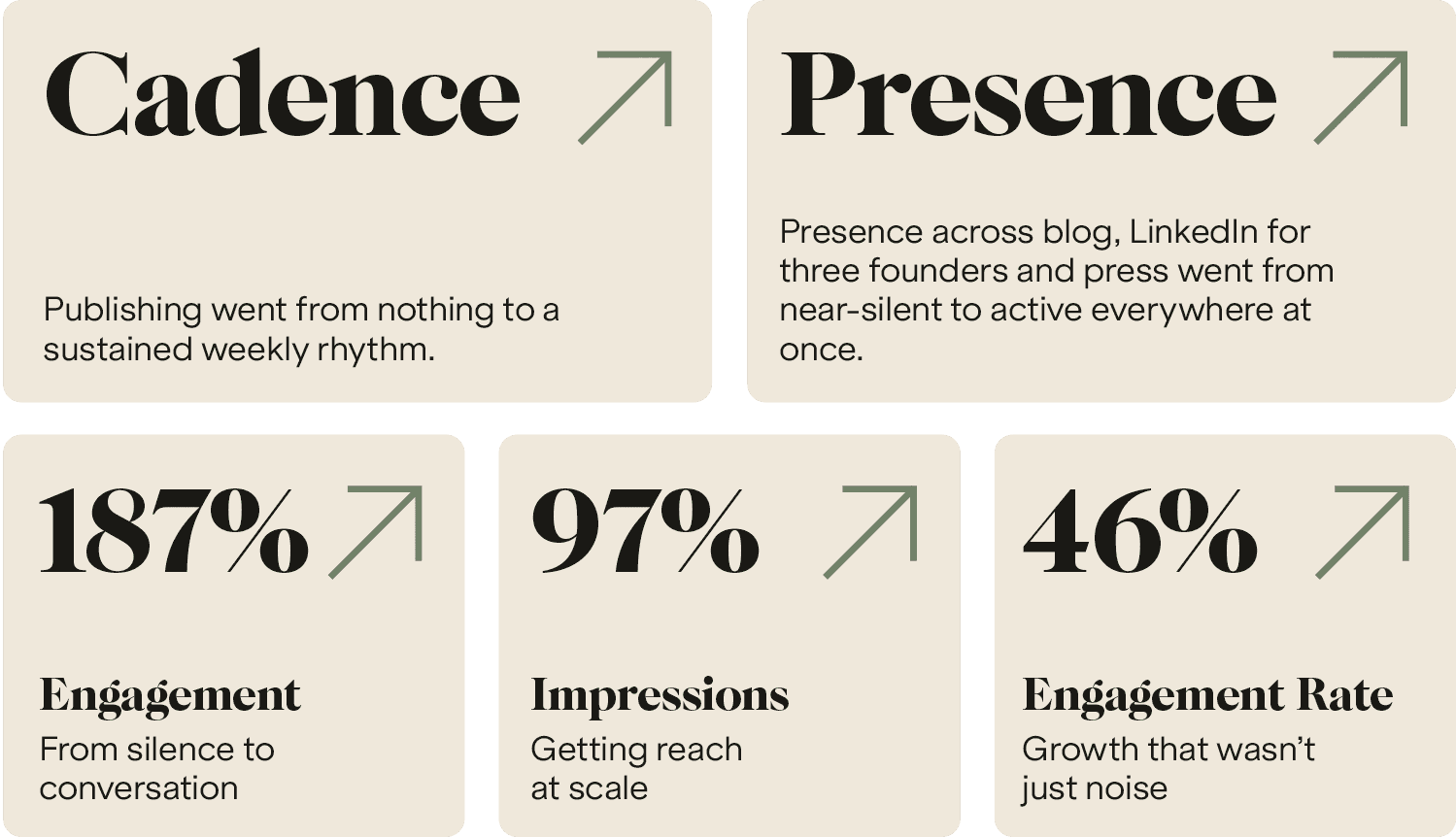
Within months, an empty publishing calendar had become a steady weekly one. Impressions rose 97% to just over 100,000 in a single quarter. Engagement rose 187% over the same period, and the engagement rate reached 46%. That last figure matters. It shows the growth came from people actually responding, not from noise.
The founders started sounding like themselves in public for the first time. The client has since extended the engagement well past its original brief, which is the clearest sign it’s working.
These numbers didn’t come from a lucky post. They came from a rhythm that someone owned.
How Grow works
Grow is the service we built for exactly this gap. It’s for owner-led businesses where marketing matters and nobody’s actual job is to do it. It is a brand-led system, run by us, that keeps the right activity happening and shows you what it changed. It is not a set number of posts.
It runs in four stages.
1. Diagnose. We look at where your business is now, how it compares with the businesses you lose work to, what content already exists and what’s working. Together we agree one primary outcome.
2. Foundations. We fix what needs fixing first. This has a fixed scope and a clear end, so you don’t have to commit to a retainer to find out whether we’re any good.
3. The Grow cycle. Ninety days of consistent activity across the channels that matter for your priority, such as content, search visibility and social.
4. Outcome review. We show you what changed against the baseline: what to keep, what to stop and what to focus on next. Then you decide whether to continue, change level or stop.
We’re clear about what we can promise. Work published to schedule, reports delivered and reviews held are ours to guarantee. Search positions, visibility and conversion are things we set targets for and work towards. Enquiries and sales are things we track and report honestly. We never promise results we don’t control.
You’ll see activity within the first month. Meaningful movement in visibility takes a full 90-day cycle, because content and search build on themselves over time and anything shorter just measures noise.
Grow works whether or not you have your own team. We can produce and publish everything, or we can set the direction, plan and standards for your team or freelancer to deliver. Either way, you own everything that’s produced, and you can pause or stop cleanly at the end of any cycle.
Is this you?
Grow is likely to be a good fit if:
Your last planning session produced good ideas that haven’t gone anywhere
Marketing is “everyone’s job” in your business, or the founder’s job on top of everything else
Your channels go quiet for weeks at a time, then get a burst of activity
You’ve no clear way of knowing whether your marketing is working
Let’s talk about who owns it
If nothing has shipped since your last planning session, the question isn’t what to do next. It’s whose job it is to make it happen.
If the honest answer is “nobody”, we’d be glad to talk it through. A 20-minute conversation is enough to see whether Grow is right for your business.
Talk to us about Grow → Complete the form below
This article expands on the October issue of Bolder, our monthly newsletter for brave brands. One idea a month, five minutes to read. [Sign up here.]